May 13, 2026
Inside a 10 cm plush: motor layout when there is room for one axis
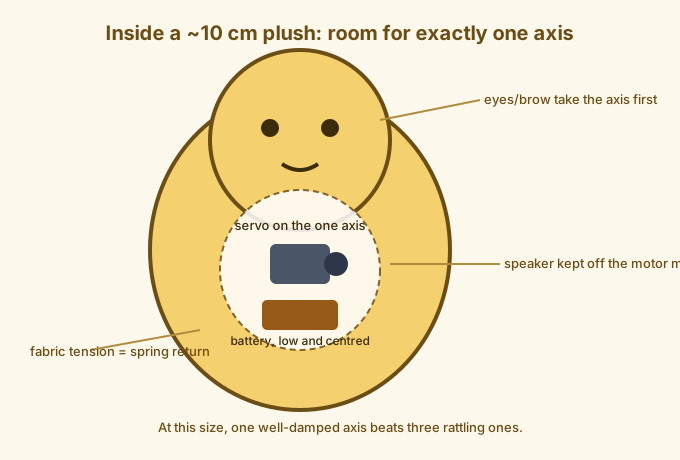
A 10-centimetre animatronic plush has room for exactly one motorized axis. The entire character reads as “alive” or “static” depending on where that axis goes — so the choice deserves more debate than it usually gets.
Eyes take the axis first, most of the time
At conversational distance, eye and brow motion carries more perceived life than any limb movement. A single axis driving blinking or brow lift, timed by the behaviour engine, outperforms three sluggish limb axes in every user test we have seen. Distance is the test: at two metres, do the eyes read? Then the axis is well spent.
The motor sits where the character balances
One axis means one moving mass, and the motor’s position sets the plush’s centre of gravity. We place the motor low and central — battery as ballast beneath it — so the character sits stably even mid-motion. Motors mounted in the head make the toy top-heavy and twitchy.
Damping is the difference between charm and rattle
Small mechanisms amplify through a plush body. Gear backlash that is invisible in a 30 cm toy becomes a rattle in a 10 cm one. Fabric tension doubles as the spring return for simple axes, and a foam bumper does the damping a gear train cannot.
What we cut, deliberately
No tail wag, no foot pads, no ear rotation at this size — each costs another motor, another driver channel and another battery drain, and none of them reads at conversational distance. The saved BOM goes into a better speaker and a quieter gearbox: two things users hear instead of see.